Cyber Security Services in Melbourne for AI Driven Threats
Artificial intelligence is changing the speed and scale of cyber attacks. It can help criminals develop convincing impersonations, investigate potential weaknesses and accelerate parts of an intrusion. For organisations seeking cyber security services in Melbourne, the priority is to understand how these threats affect their people, information and essential operations, then put effective controls in place.
Australian Signals Directorate guidance confirms that AI is accelerating vulnerability discovery and exploitation. It also emphasises that properly implemented defensive controls continue to create meaningful barriers for attackers. Organisations should strengthen their security foundations while considering how AI can improve their own defences. [1]
At Innova Communications Australasia Pty Ltd, we bring an engineering and advisory perspective to cyber security. Our services connect security strategy, risk assessment, design, testing and independent assurance with the practical requirements of operating complex systems. This is particularly valuable where telecommunications, operational technology and public safety intersect. [2, 3]
How AI changes the cyber threat landscape
AI-enabled attacks often exploit familiar weaknesses: exposed services, stolen credentials, excessive permissions and unverified requests. AI can make these attack methods faster, more convincing and easier to scale. The UK National Cyber Security Centre assesses that AI will make elements of cyber intrusion more effective and efficient through 2027. [4]
Three developments deserve particular attention:
- More persuasive social engineering. AI-generated messages and cloned voices can impersonate executives, suppliers or colleagues. Correct grammar and a familiar voice are insufficient evidence that a request is genuine. [5]
- Faster technical reconnaissance. AI can assist vulnerability research and exploit development, increasing the pressure to reduce exposure and remediate weaknesses promptly. [1, 4]
- New risks within business AI systems. AI assistants and connected applications introduce additional data flows, credentials and permissions that need security oversight. [6]
Effective defence therefore covers both attacks assisted by AI and attacks against the AI tools an organisation adopts.
Start with business risk and a reliable asset baseline
Security decisions improve when an organisation understands what it needs to protect. A useful starting point is an inventory of information, applications, devices, cloud services, operational systems and external connections, with clear ownership.
Include the AI tools employees use, the information those tools can access and any connections to email, document repositories or business applications. Unapproved AI use can otherwise create an information flow that security teams have not assessed.
Threat modelling then considers realistic attack paths and their consequences. Could a compromised supplier account reach a control system? Could an impersonated executive approve a payment? Could an AI assistant disclose restricted documents?
Innova’s information asset register development, vulnerability threat modelling and security risk assessments help turn these questions into a prioritised treatment plan. The outcome should identify actions, accountable owners, dependencies and the evidence needed to confirm improvement. [2]
Reduce exposure before attackers exploit it
Vulnerability management needs to connect discovery with remediation. A scan produces findings; security improves when the organisation validates those findings, prioritises them and fixes or otherwise controls the exposure.
We recommend prioritising internet-facing services, remote access systems, privileged accounts and assets whose compromise could disrupt essential operations. Consider whether a vulnerability is actively exploited, reachable by an attacker and connected to sensitive information or critical functions.
Practical measures include removing unnecessary public access, applying security updates, hardening configurations and retiring unsupported technology. Where immediate replacement is impractical, document the residual risk and introduce compensating controls, such as restricted connectivity and stronger monitoring.
Authorised penetration testing complements this work by examining whether weaknesses can be combined into a credible attack path. Testing should have agreed boundaries, operational safeguards and a process for retesting significant fixes. Innova provides penetration testing and security test case development and execution. [2]
Strengthen identity security against AI phishing
An attacker who obtains a valid account may be able to enter through normal business systems. Identity protection therefore needs to extend beyond password complexity.
ASD recommends phishing-resistant multi-factor authentication. Options include appropriately implemented FIDO2 security keys and passkeys, which provide stronger resistance to credential phishing than reusable passwords and many code-based methods. [7]
We recommend combining stronger authentication with:
- Separate administrative and everyday user accounts.
- Access permissions limited to the tasks each role requires.
- Reviews of supplier accounts, inactive users and application permissions.
- Secure management of API keys, service accounts and other non-human identities.
- Procedures to revoke compromised sessions and recover accounts securely.
For cloud collaboration environments, include mailbox forwarding, external sharing and third-party application consent in security reviews. These settings can create exposure even when endpoint protection is operating correctly.
Prevent deepfake fraud with verification procedures
AI-generated audio and video can support convincing impersonation. Scamwatch warns that scammers use cloned voices, fake videos and personalised messages to gain trust. [5]
The most useful response is a verification process staff can follow under pressure. For changed bank details, urgent transfers, credential resets and requests for sensitive information, confirm the request through a separately established contact channel. Use a trusted number from an existing record rather than contact details supplied in the request.
High-value payments should also require appropriate independent approval. Staff need permission to pause an unusual request, including one that appears to come from a senior executive.
Training should use realistic scenarios and reinforce reporting. Visual deepfake detection may help, but financial and access controls should remain effective even when an impersonation looks authentic.
Make monitoring lead to a clear response
Security monitoring is valuable when it connects relevant evidence to timely action. Depending on the environment, this can involve security information and event management, endpoint detection and response, identity logs, cloud audit records and network monitoring.
Useful detection scenarios include unusual privileged access, unexpected changes to security settings, abnormal data transfers and remote access outside approved arrangements. Define who reviews alerts, how incidents are escalated and who can authorise containment.
AI can assist analysts with correlation, triage and investigation. ASD’s September 2026 guidance supports these uses while emphasising governance, secure integration and human oversight. Decisions with substantial business or operational consequences need appropriate safeguards. [8]
Innova’s capability includes security operations and management advice, supported by expertise across SOC, SIEM and network monitoring disciplines. We can help organisations assess monitoring requirements and the arrangements needed to support them. Where continuous coverage is required, specify responsibilities, escalation paths and response commitments explicitly. [2, 3]
Secure the AI tools your organisation uses
Business AI adoption creates security questions beyond conventional phishing. Two important examples are prompt injection and excessive agency.
Prompt injection occurs when malicious instructions in content processed by an AI system attempt to redirect its behaviour. Excessive agency arises when an AI application has more functionality, permissions or autonomy than its purpose requires. A connected assistant could consequently perform an inappropriate action or expose information. OWASP identifies these as important application security risks. [9]
We recommend assessing each AI use case before connecting it to sensitive data or business processes. Controls should include:
- Approved tools and clearly defined permitted uses.
- Data classification rules governing what staff may upload.
- Access controls enforced by the connected systems.
- Restricted connector permissions and securely managed credentials.
- Human approval before sensitive or consequential actions.
- Logging, testing and a way to disable compromised integrations.
The OAIC recommends, as best practice, avoiding the entry of personal information, especially sensitive information, into publicly available generative AI tools. Product assessment should consider data retention, model training use, access arrangements and privacy obligations. [10]
Manage suppliers and remote access
Security assessments should cover the organisations and products connected to your environment. Consider maintenance contractors, managed service providers, cloud platforms, software vendors and AI integrations.
We recommend documenting what each supplier can access, why access is needed and how it is approved, monitored and removed. For sensitive systems, use named accounts, controlled access windows and a defined process for emergency support.
Supplier assessments should also address vulnerability disclosure, security updates, incident notification and end-of-support arrangements. For AI products, ask which external models and services process your information and what happens when those components change.
These questions help procurement, engineering and security teams identify dependencies before they become operational constraints.
Protect rail and operational technology safely
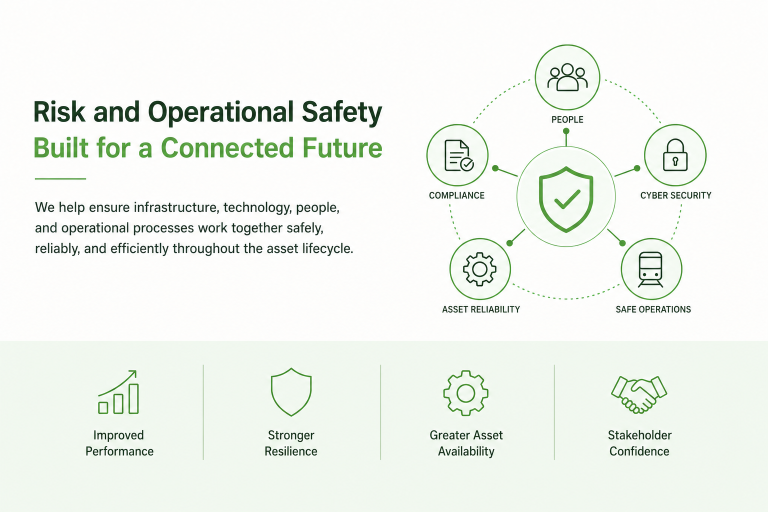
Operational technology cyber security requires an understanding of physical processes, availability and safety. A security intervention that is acceptable on an office laptop may cause disruption when applied to a control system.
ASD’s OT security principles emphasise the importance of safety, operational knowledge and collaboration between security and engineering personnel. [11]
For transport, telecommunications and other essential services, a practical assessment should consider IT/OT separation, controlled maintenance access, legacy equipment, supplier dependencies and the recovery of configurations as well as data.
Active scanning, penetration testing and automated containment need approval and validation against the operational environment. Where patching requires a planned outage or supplier approval, assess interim controls and a sustainable renewal pathway.
Innova’s published capability includes OT and railway cyber security alongside network architecture, segmentation and risk assessment. Our engineering perspective helps clients consider cyber risk within system design, operation and lifecycle management. [3, 12]
Prepare for containment and operational recovery
A useful incident response plan explains what people will do when normal systems or communications are unavailable. It should identify decision-makers, technical responders, business owners and external support arrangements.
We recommend rehearsing scenarios such as executive impersonation, ransomware, supplier compromise and the loss of an operational communications service. Exercises should test decisions about isolation, evidence preservation, stakeholder communication and restoration priorities.
Recovery planning should cover protected backups, restoration testing, trusted configuration records and the credentials needed to rebuild systems. For operational environments, define how engineering teams will confirm that restored systems can safely return to service.
Innova’s business continuity and integrity analysis, security planning and independent reviews can help clients identify gaps between documented arrangements and practical recovery needs. [2]
Understand Australian and Victorian obligations
Requirements depend on the organisation, information and assets involved. A cyber security assessment should establish which obligations apply before selecting controls or claiming compliance.
Privacy and breach notification. Entities covered by the Privacy Act must meet applicable information security obligations. Under the Notifiable Data Breaches scheme, eligible breaches generally involve likely serious harm that cannot be prevented through remedial action, subject to the scheme’s requirements and exceptions. [10, 13]
Critical infrastructure. Relevant responsible entities need to assess their obligations under the Security of Critical Infrastructure Act. Where mandatory cyber incident reporting applies, the CISC distinguishes significant availability impacts requiring notification within 12 hours from relevant impacts requiring notification within 72 hours of awareness. [14]
Victorian public sector information. The Victorian Protective Data Security Framework and Standards apply to organisations within their statutory scope. Supplier responsibilities also need to be checked against applicable contracts and information handling arrangements. [15]
ASD’s Essential Eight provides useful baseline strategies for internet-connected IT. ASD expressly notes that it was not designed for OT networks, where alternative mitigation strategies may be more appropriate. Meeting a baseline does not remove the need for an assessment tailored to the organisation’s risks. [16]
Choosing a cyber security company in Melbourne
A capable partner should explain the risks it will assess, the work it will perform and the decisions its findings will support. Ask for clear deliverables and evidence of relevant experience.
- For engineering and infrastructure environments, useful questions include:
- How will the assessment account for safety and operational continuity?
- What will testing cover, and how will disruption be controlled?
- How will findings be prioritised and remediation verified?
- Who will own ongoing monitoring, escalation and response?
- How will supplier dependencies and AI integrations be assessed?
- What evidence will management receive to understand residual risk?
An effective engagement should leave the organisation with a clear treatment plan and a practical way to measure progress.
How Innova Communications can help
Innova combines cyber security capability with telecommunications, systems engineering and operational risk expertise. We support clients through strategy, requirements analysis, security design, threat modelling, risk assessments, penetration testing, policy development and independent assurance. [2, 12]
For organisations seeking cyber security services in Melbourne, this means advice that considers technical weaknesses, business priorities and the realities of maintaining essential systems.
Whether you are reviewing AI adoption, strengthening IT and OT security, or assessing incident readiness, we can help define the work required and prioritise practical next steps.
Contact Innova Communications for an initial consultation about your cyber security requirements.
Frequently asked questions
How is AI used in cyber attacks
AI can assist social engineering, impersonation, vulnerability research and parts of exploit development. Its effect varies with the task, attacker capability and target environment. Organisations should address the underlying weaknesses attackers seek to exploit. [1, 4, 5]
What should cyber security services in Melbourne include
The scope should reflect your risks. It may include asset discovery, threat modelling, security risk assessment, architecture review, penetration testing, governance, monitoring requirements and incident preparedness. Define deliverables and ongoing responsibilities before engagement.
Does Innova offer penetration testing
Yes. Innova’s published cyber security services include penetration testing and security test case development and execution. Testing scope and operational safeguards are agreed for the relevant environment. [2]
Does MFA stop AI phishing
MFA reduces account compromise risk, but methods differ. ASD recommends phishing-resistant MFA. Organisations should also secure account recovery, device access, active sessions and application permissions. [7]
Is the Essential Eight sufficient for OT cyber security
The Essential Eight was designed for internet-connected IT. OT requires assessment of operational processes, safety, availability and system constraints, with controls selected accordingly. [11, 16]
How much does a cyber security assessment cost
Cost depends on scope, system complexity, number of sites, testing requirements and access constraints. Agree the systems included, required outputs and any operational restrictions so the assessment can be priced on a clear basis.
RESEARCH SOURCES
Sources reviewed 17 October 2026. Bracketed numbers in the article map to this list. In the published blog, convert selected references into descriptive source links and remove editorial notes.
[1] Australian Signals Directorate — Frontier AI models and their impact on cyber security. Published 30 April 2026; reviewed 8 May 2026.
[2] Innova Communications — Cyber Security. Published service scope.
[3] Innova Communications — Innova’s Cyber Security Services. Published capability matrix.
[4] UK National Cyber Security Centre — Impact of AI on cyber threat from now to 2027. Published 7 May 2025.
[5] Scamwatch — How scammers use technology and AI.
[6] ASD — Protect your organisations’ AI services.
[7] ASD — Implementing multi-factor authentication.
[8] ASD — Opportunities for AI in cyber defence. Published and reviewed 8 September 2026.
[9] OWASP Gen AI Security Project — Excessive Agency and LLM application risks.
[10] OAIC — Guidance on privacy and the use of commercially available AI products.
[11] ASD — Principles of operational technology cyber security.
[12] Innova Communications — About Us.
[13] OAIC — When to report a data breach.
[14] Critical Infrastructure Security Centre — SOCI Act regulatory obligations.
[15] OVIC — Victorian Protective Data Security Framework.
[16] ASD — Essential Eight explained.
[17] Google Search Central — Changes to HowTo and FAQ rich results.