How Leadership Blind Spots Can Undermine Risk and Operational Safety Strategies?
Modern infrastructure requires strong leadership to ensure safe, resilient, and reliable operations. However, even experienced leaders may have blind spots, leaving them unable to recognize emerging risks or operational gaps. These blind spots can compromise governance structures and damage the Risk and Operational Safety strategies within an organization if left unaddressed.
At Innova Communications, we collaborate with government bodies, utility companies, transport companies, and enterprise organizations to enhance the resilience and security of operations. We are a reliable cybersecurity and advisory partner with operations in Melbourne, safeguarding nationally significant infrastructure and global operations against the ever-increasing complexity of operations and cyber threats.
This blog discusses how leadership blind spots form, how they can influence Risk and Operational Safety, and how organizations can address them through enhanced governance, communication, and comprehensive risk management.
Understanding Leadership Blind Spots
Leadership blind spots occur when decision-makers unknowingly ignore risks, assumptions, and operational realities that affect safety performance. These loopholes tend to arise because executives are more focused on high-level strategy, whereas operational risks are at the ground level.
In cases of poor communication with operational teams, leaders can use reports, dashboards, or compliance metrics to learn more about the actual safety picture, which is often inaccurate. Consequently, the Risk and Operational Safety strategies might seem to work on paper, but they do not meet the operational challenges at the ground level.
Through our practice in advising, we have observed that these blind spots need to be addressed through structured governance, an open channel of communication, and an independent review mechanism.
The Complexity of Modern Infrastructure Environments
The current critical infrastructure environment is based on interconnected digital systems, industrial automation, and operational technologies. Transport systems, utilities, and large enterprise systems are running on integrated digital and physical infrastructures.
As a cybersecurity firm that provides safety-critical facilities, we are aware that operational risks often overlap with digital vulnerabilities. Cyber incidents can escalate rapidly when critical platforms, such as industrial control systems, signalling networks, or power infrastructure, are affected.
This is why cyber threats should be included in organizations’ Risk and Operational Safety planning. Good leadership must understand the interplay between cyber resilience, operational continuity, and safety management to ensure the security of vital services.
Overconfidence in Policies and Technology
The other popular leadership pitfall is assuming that policies or technologies can guarantee safe operations. Though governance structures, safety protocols, and monitoring processes are needed, they should not be used to substitute for active supervision and ongoing review.
The use of advanced technologies such as real-time visibility platforms, threat detection, and automated controls can go a long way toward improving operational visibility. Nevertheless, these tools, unless controlled by humans with inherent risk management skills, can conceal underlying weaknesses within the organization.
Innovà Communications can assist organizations in protecting Operational Technology (OT), ICS, and SCADA environments whilst ensuring that cyberattacks do not disrupt systems supporting safety-critical processes. In our work, we enhance IT/OT segmentation, implement secure network architectures, and provide real-time threat detection capabilities. These controls reinforce stronger Risk and Operational Safety approaches by securing key systems.
The Impact of Communication Gaps
Safety information in many organizations often flows through several teams before reaching leadership, especially in complex organizations. Without clear or broken communication structures, essential safety information might never reach decision-makers.
Leadership blind-spots are often formed when:
- Operational staff hesitate to report concerns
- Data is filtered through multiple reporting layers
- Safety insights are overshadowed by performance targets
When communication breaks down, the quality of Risk and Operational Safety decision-making declines significantly.
To solve this dilemma, organizations have to open up reporting lines, foster open communication, and promote an environment where safety issues are handled quickly and transparently.
The Role of Cyber Security in Operational Safety
Cybersecurity has now become an essential part of operational safety as the infrastructure systems become more digital. Any cyber intrusion into industrial systems may disrupt services, destroy infrastructure, and threaten citizens’ lives.
Innova Communications is a skilled Cyber Security Company based in Melbourne that assists organizations to increase their cyber resilience in high-risk settings. Our services help infrastructure operators by:
- Securing Operational Technology environments
- Protecting industrial control systems from cyber disruption
- Conducting advanced risk assessments and security assurance
- Supporting incident response and rapid operational recovery
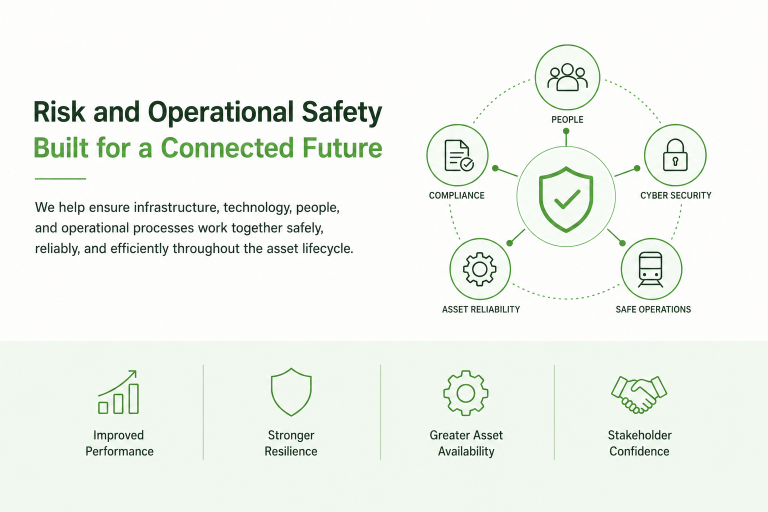
The activities are useful for ensuring the continuity of critical services within organizations and for enhancing the risk and Operational Safety of interdependent digital and physical systems.
Integrating Cyber Security with Functional Safety
Integrating cybersecurity plans with overall safety and protection systems is one of the most effective ways to mitigate leadership blind spots.
The current infrastructure system relies on interconnected technologies, and a cyberattack could disrupt operations or cause safety accidents. This is why organizations have to adopt a combination of protection measures that are mindful of both cyber threats and operational risks.
At Innova Communications, we incorporate security-by-design concepts into the infrastructure lifecycle and align cyber controls with functional safety considerations. This will safeguard physical and online resources and help in hazard analysis and resilience planning.
When organizations combine these structures, they can make their Risk and Operational Safety programs quite strong.
The Importance of Standards and Compliance
Another factor contributing to the eradication of leadership blind spots is adherence to globally accepted security and governance standards. Compliance frameworks offer systematic guidance on identifying vulnerabilities, managing risk, and ensuring accountability.
Innova Communications helps organizations to align their cybersecurity programs with the best international frameworks, including:
- ISO/IEC 27001 and 27002
- IEC 62443 for industrial automation security
- NIST Cybersecurity Framework
- NIST SP 800-82 for industrial control systems
- Australian Cyber Security Centre Essential Eight
- CIS Critical Security Controls
When operational strategies align with such frameworks, organizations enhance governance and visibility in the Risk and Operational Safety environment.
Strengthening Leadership Visibility Over Risk
Leadership blind spots are common in organisations managing complex infrastructure, but they can be reduced through strong oversight, integrated risk management, and clear communication.
By combining cyber security expertise, operational governance, and engineering advisory services, Innova Communications helps organisations protect critical infrastructure while maintaining operational continuity.
As a trusted Cyber Security Company in Melbourne, we work with leadership teams and technical experts to deliver practical solutions that strengthen resilience and keep Risk and Operational Safety a top priority.
Safer infrastructure begins with informed leadership, transparent governance, and proactive strategies that address risks before they escalate.