Risk and Operational Safety: The Foundation of Reliable Rail and Critical Infrastructure Operations
Why Risk and Operational Safety Matter More Than Ever
Modern railways, telecommunications networks, critical infrastructure, and public transport systems are becoming increasingly interconnected and technology dependent. As systems become more complex, organisations must manage not only traditional operational risks but also safety, cyber security, asset reliability, human factors, and regulatory compliance risks.
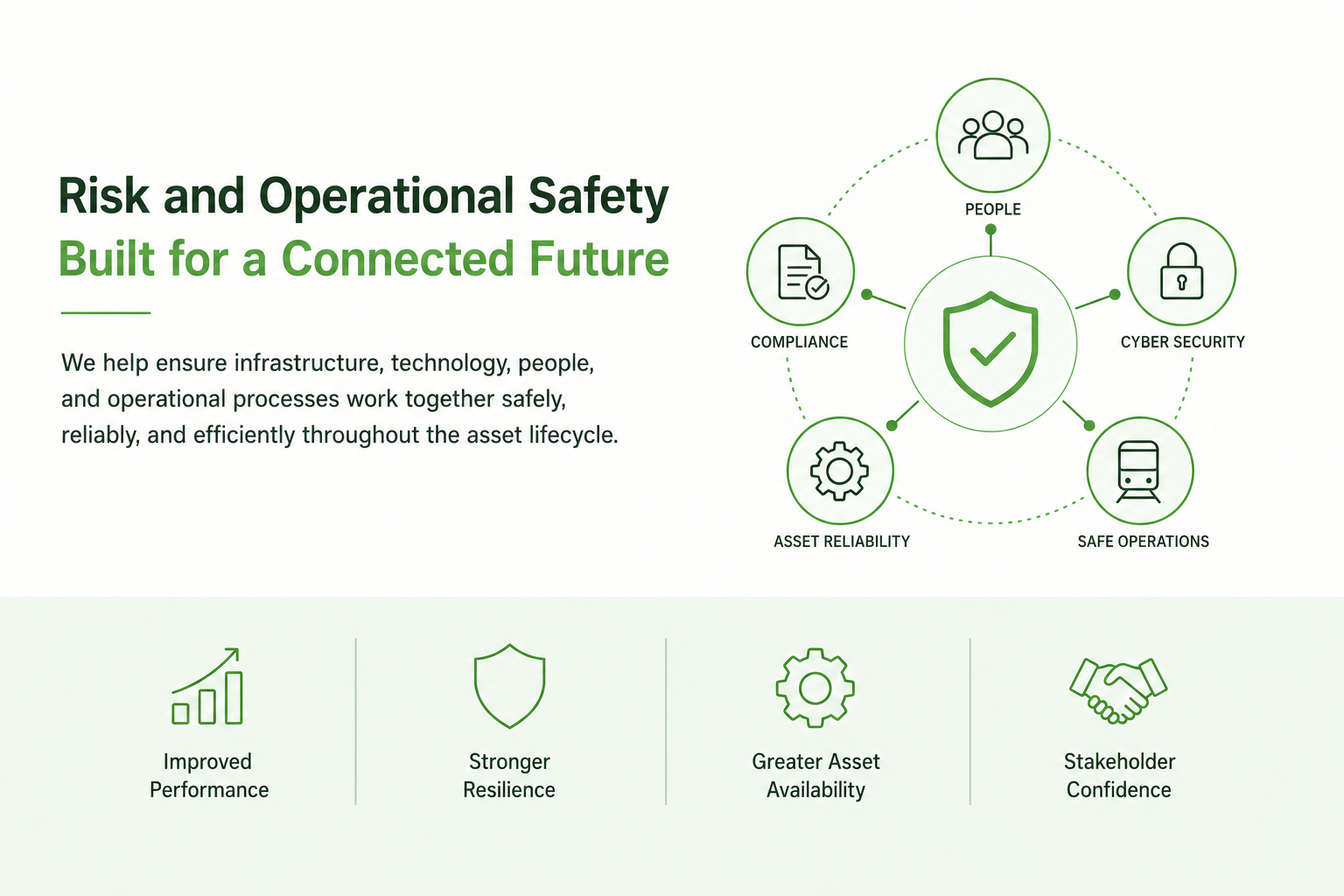
At Innova Communications Australasia Pty Ltd, we believe Risk and Operational Safety is not simply about compliance. It is about ensuring infrastructure, technology, people, and operational processes work together safely, reliably, and efficiently throughout the entire asset lifecycle.
When implemented effectively, Risk and Operational Safety Management delivers measurable improvements in operational performance, network resilience, asset availability, and stakeholder confidence.
Identifies Hazards Before They Become Operational Incidents
Most major operational failures are preceded by warning signs. Whether it is a signalling anomaly, telecommunications outage, control system defect, cyber vulnerability, or maintenance deficiency, the challenge is identifying and addressing the risk before it escalates.
A structured Risk and Operational Safety framework enables organisations to systematically identify hazards, assess consequences, and implement controls before incidents occur.
This proactive approach helps organisations:
- Identify safety-critical vulnerabilities early
- Reduce operational and project delivery risks
- Prevent service disruptions and asset failures
- Improve workforce and passenger safety
- Reduce whole-of-life operational costs
For rail and transport operators, this can mean the difference between a manageable maintenance activity and a network-wide operational disruption.
Supports Better Operational Decision-Making
Operational decisions are only as effective as the information available to decision-makers.
Risk and Operational Safety Management provides structured processes for understanding:
- What hazards exist
- What controls are in place
- Whether controls remain effective
- What residual risks remain
This enables operational leaders, engineering managers, maintenance teams, and project stakeholders to make informed decisions based on evidence rather than assumptions.
Whether managing a live railway corridor, operational control centre, telecommunications network, or critical infrastructure asset, organisations benefit from greater transparency and confidence when making safety-critical decisions.
Improves Network Reliability and Asset Availability
For rail operators, telecommunications providers, and critical infrastructure owners, reliability is fundamental.
Risk and Operational Safety processes support asset reliability through:
- Failure Modes, Effects and Criticality Analysis (FMECA)
- Reliability, Availability, Maintainability and Safety (RAMS) assessments
- Asset lifecycle risk analysis
- Maintenance optimisation
- Obsolescence and technology risk management
By understanding how systems may fail and the consequences of those failures, organisations can proactively target maintenance activities, optimise investment decisions, and extend asset life while maintaining acceptable safety levels.
The result is reduced downtime, improved service availability, and greater operational resilience.
Embeds Safety into Design from Day One
One of the most common causes of cost overruns and operational issues is attempting to address safety concerns too late in a project lifecycle.
Safety in Design (SiD) principles ensure hazards are identified and mitigated during planning and design rather than after construction or commissioning.
Early integration of safety considerations delivers:
- Reduced redesign costs
- Improved project delivery certainty
- Faster approvals and accreditation
- Reduced operational risk exposure
- Improved maintainability and operability
For major rail and telecommunications projects, incorporating Safety in Design from project inception is one of the most effective ways to improve long-term outcomes.
Strengthens Operational Readiness and Transition Planning
Introducing new technology into operational environments carries significant risk.
Whether transitioning to a new communications platform, control system, signalling system, operational technology network, or digital railway capability, organisations must ensure people, processes, technology, and governance are aligned before entering service.
Operational Readiness and Transition Planning helps organisations:
- Validate operational procedures
- Confirm training effectiveness
- Assess emergency response arrangements
- Verify maintenance readiness
- Demonstrate system acceptance requirements
This reduces implementation risk and supports safe and successful transition into operational service.
Addresses Emerging Cyber and Safety Risks
As railways and critical infrastructure become increasingly digitised, cyber security and safety can no longer be treated separately.
Modern operational environments rely heavily on interconnected systems including:
- Operational Control and Management Systems (OCMS)
- Telecommunications networks
- Signalling systems
- Train control systems
- Industrial control systems
- Cloud and data platforms
Industry standards increasingly recognise the convergence of safety and cyber security risk management, requiring organisations to manage both disciplines together to maintain safe operations.
An integrated approach improves resilience against both accidental failures and malicious threats while supporting compliance with contemporary industry standards.
Supports Regulatory Compliance and Accreditation
Rail and critical infrastructure operators operate within highly regulated environments where demonstrating safety assurance is essential.
Risk and Operational Safety Management provides the evidence required to support:
- Safety Cases
- Type Approvals
- Safety Management Systems
- Independent Safety Assessment (ISA)
- Accreditation activities
- Operational readiness reviews
- Engineering change management
By developing robust safety documentation and assurance processes early, organisations can significantly reduce approval timelines and avoid costly project delays.
Builds a Stronger Safety Culture
Processes alone do not create safe organisations. People do.
A mature Risk and Operational Safety framework helps embed safety thinking into everyday activities by:
- Promoting proactive risk identification
- Encouraging reporting and learning
- Supporting continuous improvement
- Improving workforce engagement
- Establishing accountability across all levels
When safety becomes part of organisational culture rather than simply a compliance obligation, organisations become more resilient, adaptable, and operationally effective.
Why Organisations Choose Innova
Innova Communications Australasia provides specialist Risk and Operational Safety services across rail, telecommunications, transport, emergency services, and critical infrastructure sectors.
Our capabilities include:
- Hazard Identification and Risk Management
- Safety in Design (SiD)
- Safety Assurance and Verification
- FMECA and RAMS Analysis
- Safety Cases and Type Approval Support
- Operational Readiness and Transition Planning
- Human Factors Assessment
- Safety Management Systems
- Asset Lifecycle Risk Management
- Independent Reviews and Due Diligence
- Infrastructure and Maintenance Auditing
- Accreditation Advisory Services
Our multidisciplinary team combines practical operational experience with engineering, systems assurance, telecommunications, cyber security, and railway safety expertise to deliver safe, reliable, and sustainable outcomes for our clients.
Frequently Asked Questions
What is Risk and Operational Safety Management?
Risk and Operational Safety Management is the systematic process of identifying hazards, assessing risks, implementing controls, and providing assurance that systems can operate safely throughout their lifecycle.
Why is Risk and Operational Safety important in rail environments?
Rail systems are complex, safety-critical environments where failures can impact passengers, workers, operations, and infrastructure. Effective safety management helps prevent incidents, improve reliability, and support regulatory compliance.
What is the difference between Safety Assurance and Risk Management?
Risk Management focuses on identifying and controlling hazards. Safety Assurance provides evidence that those controls are effective and that the system is safe for operation.
How does FMECA improve asset performance?
Failure Modes, Effects and Criticality Analysis (FMECA) identifies how components may fail, the consequences of those failures, and which risks require priority attention, enabling more effective maintenance and asset management.
Can cyber security affect operational safety?
Yes. Modern rail and telecommunications systems are increasingly interconnected. Cyber security incidents can impact availability, integrity, and safety-critical functions, making integrated safety and cyber risk management essential.
What standards are commonly used for rail safety assurance?
Common standards include EN 50126 (RAMS), EN 50128, EN 50129, EN 50159, TS 50701, IEC 62443, and relevant Australian rail safety legislation and accreditation frameworks.